Vegetable by vegetable
Pickled carrots, and a brine where the salt is not the preservative
The clearest published example of a recipe whose salt is there for taste and whose safety rests entirely on the vinegar.
On this page
On this page
The carrot is the clearest published example in the national guide of a recipe whose salt is there for taste and whose safety rests entirely on the vinegar. The two recipes are Pickled Carrots and Pickled Baby Carrots, both developed at The University of Georgia, Athens, for the National Center for Home Food Preservation and released in October 2005 in Guide 6. Everything below comes from that single source, and every quantity is printed there.
Yield and the full measure of brine
Pickled Carrots yields about 4 pint jars. The recipe calls for 2¾ lbs of peeled carrots, which is roughly 3½ lbs as purchased, so buy accordingly (the national guide, Guide 6).
The brine is built on a striking ratio: 5½ cups of 5 % distilled white vinegar to 1 cup of water, a vinegar-to-water ratio of 5.5 to 1. Alongside it go 2 cups of sugar and 2 tsp of canning salt. The guide specifies 5 % acidity for the vinegar; do not substitute a vinegar of unstated strength.
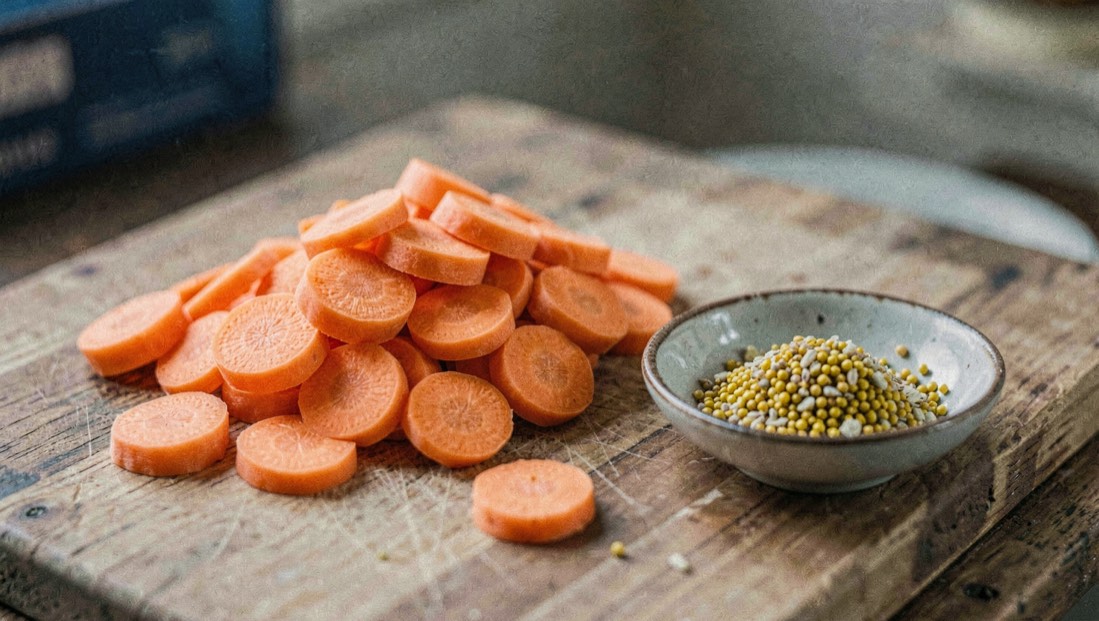
The spices are added whole to the jars, not to the brine: 2 tsp of mustard seed and 1 tsp of celery seed per pint, placed dry at the bottom of each jar before packing.
The salt is not the preservative here
In this recipe the canning salt, 2 tsp for about 6½ cups of liquid, is present for flavor only. The safety of these carrots rests entirely on the vinegar and the heat processing. Lowering the vinegar or lengthening the water would change the safety of the product, not just its taste.
Washing twice, and cutting half-inch rounds
The guide is unusually explicit about cleaning, because carrots grow in soil. It reads: "Wash and peel carrots well. Wash again after peeling and cut into rounds that are approximately ½-inch thick." That is a double wash, once before peeling and once after, and it is not optional language. No accepted source states why the rounds must be about 1/2 inch thick; the thickness is printed as part of the preparation.
A ten-minute pre-cook, stopped at half-cooked
The carrots are brought to a boil and simmered "until the carrots are half-cooked (about 10 minutes)". This is a hot pack recipe: the carrots go into the jars hot, with the brine, and the boiling water bath finishes the cook. The guide does not explain why it stops at half-cooked rather than fully cooked, and no reason is published; follow the timing as given rather than judging doneness by eye.
Headspace in two steps
This recipe uses a two-stage headspace that differs from the single measurement most pickle recipes use. First, leave 1 inch of headspace when the carrots are packed into the jar. Second, after the hot liquid is added, the headspace becomes ½ inch. In practice this means the liquid is poured to within ½ inch of the rim, over carrots that were packed to 1 inch. The two figures are both printed in the national guide, and both are needed to fill the jars correctly.
The processing times and what follows the bath
The process is hot pack in pint jars only, at 15, 20, or 25 minutes depending on altitude, exactly as printed in the national guide. No quart time is published for this recipe.
| Pack | Jar size | Process time |
|---|---|---|
| Hot pack | Pints | 15 / 20 / 25 minutes by altitude |
After processing, let the jars cool undisturbed for 12 to 24 hours, then check the seals. The guide then adds a step that many pickle recipes omit: "Allow carrots to sit in processed jars for 3 to 5 days before consuming for best flavor development." Opening a jar the day after processing is not what the recipe describes.
The baby carrot variant, same brine and same process
Pickled Baby Carrots uses an identical brine, the same 5.5 to 1 vinegar-to-water ratio, and the same yield of about 4 pints. The differences are the vegetable itself: 8½ cups of peeled baby carrots, left whole and unsliced, so no slicing step applies. The source prints the same brine, the same yield, and the same processing schedule, and does not restate the preparation steps. The processing schedule is the same: hot pack, pints, 15, 20, or 25 minutes by altitude (the national guide, Guide 6).
What the accepted sources do not publish
No fermented carrot recipe is found in the accepted sources. The national guide publishes only these two vinegar pickles for carrots, Pickled Carrots and Pickled Baby Carrots, and a search of the accepted sources for a lacto-fermented carrot turns up nothing. This page therefore says nothing about fermentation times, brine percentages, or storage for fermented carrots, because no such figures are published. It also gives no altitude bands beyond referring you to the 15, 20, and 25 minute times as printed, and no quart-jar processing time, since none is published for either recipe.
Sources of the figures on this page
- National Center for Home Food Preservation, University of Georgia, Pickled Carrots and Pickled Baby Carrots, developed at the University of Georgia for the NCHFP, released October 2005; USDA Complete Guide to Home Canning, guide 6. The 5.5 to 1 vinegar to water ratio, the ten minute part cooking, the two stage headspace and the three to five day rest before eating.
- United States Department of Agriculture, Complete Guide to Home Canning, Agriculture Information Bulletin 539, guide 6, Preparing and Canning Fermented and Pickled Foods, revised 2015. The canon these extension leaflets adapt, and by its silences, the vegetables for which nothing is published.
- National Center for Home Food Preservation, University of Georgia, General Information on Pickling, adapted from the USDA Complete Guide to Home Canning, revised 2015, reviewed February 2018. The four classes of pickled product, the 5 percent vinegar requirement, and the prohibition on altering proportions.