Vegetable by vegetable
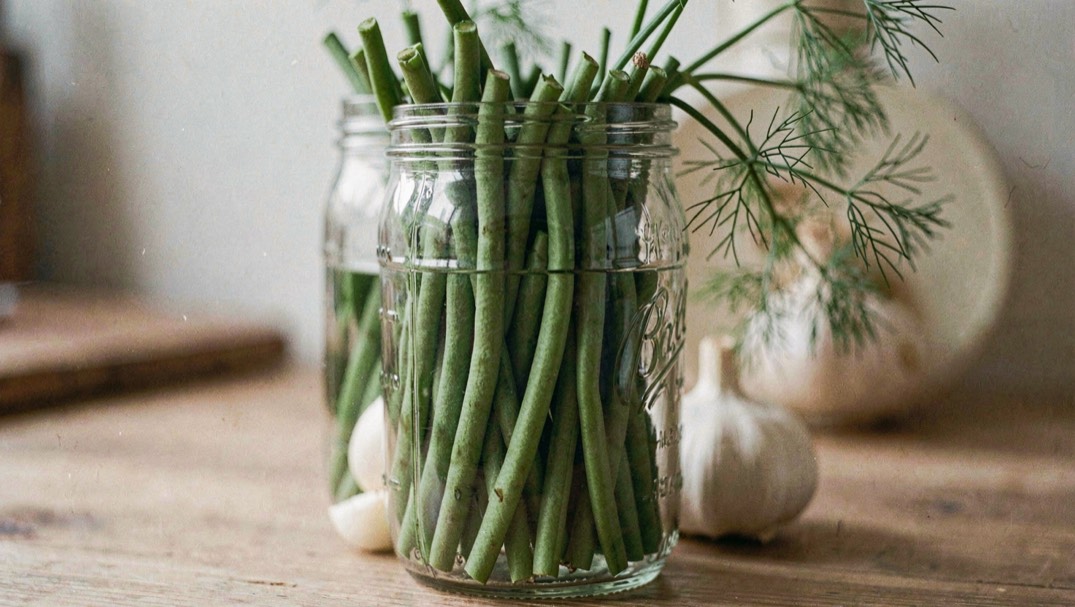
Dilled beans, upright in the jar and never fermented
A fresh pack recipe with one of the shortest processing times published, and no fermented version anywhere in these sources.
On this page
On this page
This page records the one fresh-pack dilled bean recipe carried by the accepted sources. It is a vinegar pickle, canned in a boiling water bath, and it is not a fermentation. The recipe appears in Oregon State's PNW 355 as a USDA Complete Guide to Home Canning recipe, and in the national center's Guide 6 presentation of the same recipe, revised 2015. No source in this manual publishes a lactic fermentation of green beans of any kind.
What the recipe takes, and what it yields
Both publications print the same quantities. The national center, in Guide 6, page 6-14, gives the yield as about 8 pints. The ingredients are:
- 4 lbs of fresh, tender green or yellow beans, 5 to 6 inches long.
- 8 to 16 heads of fresh dill, or sprigs of basil in the PNW 355 version.
- 8 cloves of garlic, optional.
- 1/2 cup of canning or pickling salt.
- 4 cups of white vinegar at 5 percent acidity.
- 4 cups of water.
- 1 teaspoon of red pepper flakes, optional.
The brine is half vinegar and half water, a 1:1 ratio, with the 1/2 cup of salt measured against the 8 cups of liquid, as the national center states. The vinegar is specified at 5 percent acidity; do not substitute a vinegar of unknown strength.
Why the beans are cut to 4 inches
The instruction is quoted directly by the national center: "Wash and trim ends from beans and cut to 4-inch lengths." The cut is a packing instruction, not a cooking one. No accepted source states why the beans are cut to 4 inches; the length is printed as part of the pack instruction, alongside the upright pack and the 1/2 inch of headspace. Neither source instructs blanching, so there is no blanching step to add or guess at.
Packing the jar upright, with sterilized jars
Both presentations agree on the pack. Wash and trim the beans, cut them to 4-inch lengths, and set them upright in hot, sterilized pint jars. Leave 1/2 inch of headspace. Bring the brine to a boil and pour it over the beans to cover them. This is a raw pack: the beans go into the jar raw, and the only heat they receive before processing comes from the boiling brine. Jar sterilization is stated explicitly by the national center, so it is part of the recipe rather than an optional refinement.
Standing beans, 4 inches, half an inch of headspace.
The cut length and the upright pack are one instruction, not two. A bean too long for the jar is a bean packed wrong.
The processing schedule, one of the shortest in this manual's sources
The national center, attributed to the USDA revision of 2015, prints a three-step altitude schedule for pints, and Oregon State's PNW 355 prints the same figures. Five minutes is the base time, which makes this one of the shortest boiling water bath schedules published anywhere in the sources this manual draws on.
| Altitude | Processing time |
|---|---|
| 0 to 1,000 ft | 5 min |
| 1,001 to 6,000 ft | 10 min |
| Above 6,000 ft | 15 min |
Two altitude rules that do not agree
Clemson's HGIC 3400, Pickled Foods, revised February 5, 2001, publishes the same dilled bean recipe with a different altitude adjustment. Its rule reads: "For those living at altitudes between 1000 and 2000 feet, add 5 minutes to each processing time." Its base instruction is "Process 5 minutes in a boiling water bath." The national center's three-tier schedule, revised 2015, is the more recent presentation, and its tiers do not map cleanly onto Clemson's single addition of five minutes between 1,000 and 2,000 feet.
These two rules do not agree, and this manual does not arbitrate between them. Use the schedule of the source you are following, in full, and never combine the two. If you process by the national center's table, apply its tiers as printed. If you process by Clemson's older revision, apply its five-minute addition as printed. Mixing the base time from one with the adjustment from the other produces a schedule no source publishes.
What the sources do not say about storage life
The national center's page for this recipe displays no storage duration; it is not published there. This manual will not supply a number the source does not print. No accepted source in this manual publishes a shelf life for these dilled beans, so the question of how long the jars keep is answered by the same phrase everywhere: not found.
What this page does not say is as important as what it does. No source accepted by this manual publishes a fermented green bean of any kind, so there is no brine percentage, no fermentation time, and no room temperature holding instruction to give for green beans here. This page also does not treat quart jars, raw packed or otherwise, because the sources print this recipe for pints only. And it does not reprint any storage duration for the canned pickles, because none is published on the page this recipe comes from.
Sources of the figures on this page
- Oregon State University Extension Service, Pickling Vegetables, PNW 355, by Jeanne Brandt, revised July 2019, reviewed 2024. Equipment, water, salt and vinegar, the fermentation procedures and seventeen tested recipes.
- National Center for Home Food Preservation, University of Georgia, General Information on Pickling, adapted from the USDA Complete Guide to Home Canning, revised 2015, reviewed February 2018. The four classes of pickled product, the 5 percent vinegar requirement, and the prohibition on altering proportions.