Vegetable by vegetable
Pickled hot peppers, blistered before they are packed
The one recipe on this site that carries a safety instruction about the cook rather than the food, and the only one with a skin removal step.
On this page
On this page
- The published quantities, yield, and the brine that carries them
- Gloves, or soap and water, before you touch your face
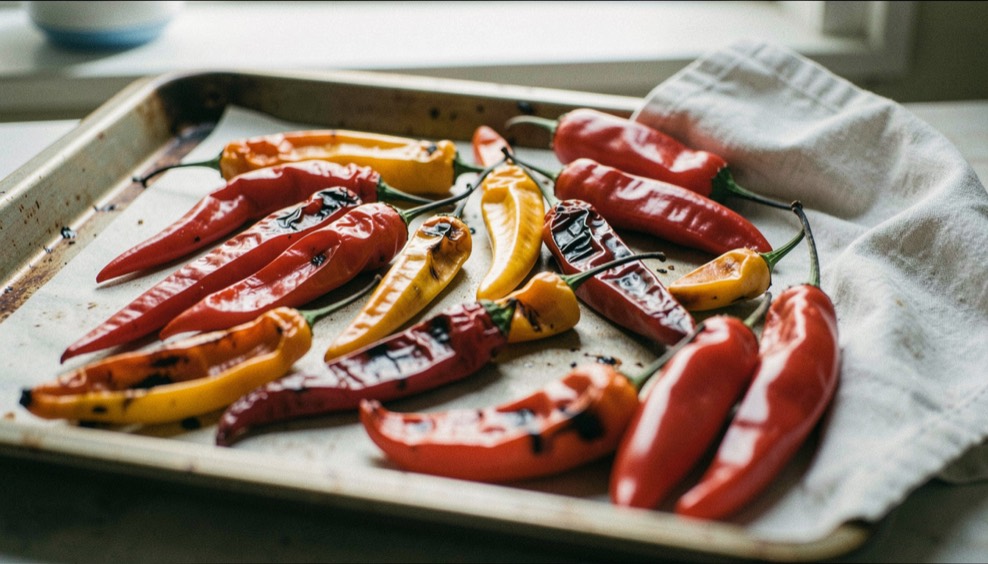
- Slitting small peppers and blistering the skins
- Simmering the solution, headspace, and the processing table
- Five published recipes around the pepper, and what separates them
- The 18-hour lime soak, and why the rinsing is not optional
This page covers the fresh-pack recipe for pickled hot peppers as printed in Oregon State's PNW 355, which is the one recipe in this manual that carries a safety instruction about the cook rather than about the food, and the only one that asks you to remove the pepper skins before packing. Both warnings exist for reasons the source states plainly: capsaicin burns skin, and the skins are peeled because they blister and loosen under heat.
The published quantities, yield, and the brine that carries them
The recipe calls for 4 lbs of long red, green, or yellow hot peppers, with Hungarian, banana, chile, and jalapeño named as suitable types, plus 3 lbs of mixed sweet red and green peppers. The pickling solution is 5 cups of 5 percent vinegar, 1 cup of water, 4 tsp of salt, 2 tbsp of sugar, and 2 cloves of garlic. That is a vinegar-to-water ratio of 5:1. The published yield is about 18 half-pints or 9 pints.
Gloves, or soap and water, before you touch your face
The source prints this instruction in its own words: "To prevent burns, wear rubber gloves when you handle hot peppers, or wash your hands thoroughly with soap and water before touching your face." The national guide prints the same instruction in different words: "Caution: Wear rubber gloves when handling hot peppers or wash hands thoroughly with soap and water before touching your face." This is the only operator-safety line attached to any pepper or pickle recipe in the corpus. It exists, as the sentence itself says, to prevent burns to the cook, not to protect the food.
Slitting small peppers and blistering the skins
Small peppers left whole are slit 2 to 4 times each. Large peppers are cut into quarters. Then comes the step that separates this recipe from every other hot-pepper pack on this site: the skins are loosened by heat before peeling. Two methods are published. You can blanch the peppers in boiling water, or you can blister the skins. The blistering instructions read: "Place peppers in a hot oven (400ºF) or broiler for 6-8 minutes or until skins blister." A range-top method is also published, in which peppers are placed on a burner for several minutes until the skins blister.
After heating, the peppers are covered with a damp cloth, then peeled. The national guide, which prints the same recipe with the same quantities, states the sequence as "Cool and peel off skin." No source in this manual explains why the damp cloth step matters; it is printed as an instruction without a stated reason.
Simmering the solution, headspace, and the processing table
The remaining ingredients, meaning the vinegar, water, salt, sugar, and garlic, are simmered 10 minutes, and the garlic is removed before packing. The headspace is ½ inch, the same half-inch headspace that appears in all five published pepper recipes. The peppers are packed raw, not hot, and processed in a boiling-water bath. Oregon State's PNW 355 prints this table:
| Jar size | 0 to 1,000 ft | 1,001 to 6,000 ft | Above 6,000 ft |
|---|---|---|---|
| Half-pint | 10 min | 15 min | 20 min |
| Pint | 10 min | 15 min | 20 min |
Five published recipes around the pepper, and what separates them
The national guide publishes five fresh-pack pepper recipes in total. All five use a ½-inch headspace. Beyond that shared figure, they differ in brine ratio, in sugar, in jar sterilization, in heat level, and in one case in an 18-hour lime soak. In outline:
- Pickled Bell Peppers. Sweet peppers only. A 1:1 ratio of vinegar to water, 3½ cups of sugar, and jars that must be sterilized, with ¼ tsp of salt and ½ garlic clove per sterilized half-pint, doubled per pint. Packed hot and processed 5, 10, or 15 minutes depending on altitude.
- Pickled Hot Peppers. The recipe on this page. A 5:1 vinegar ratio, packed raw, processed 10, 15, or 20 minutes.
- Marinated Peppers. The only published recipe in the corpus that contains oil, 1 cup of olive or table oil. It is acidified with 2 cups of 5 percent white vinegar and 1 cup of bottled lemon juice; fresh lemon juice is not permitted, because bottled juice has a standardized acidity. It also publishes a heat scale: 4 lbs of jalapeños for hot, 2 lbs for medium, 1 lb for mild.
- Pickled Yellow Pepper Rings. Banana peppers sliced into ¼-inch rings, a 4:1 cider-vinegar ratio, no sugar at all, and spices placed in the jar rather than in the brine.
- Pickled Jalapeño Rings. The only recipe with a lime step, described below.
The 18-hour lime soak, and why the rinsing is not optional
The jalapeño rings recipe calls for soaking the pepper slices in a lime-water solution, 1½ cups of pickling lime in 1½ gallons of water, in the refrigerator for 18 hours, stirring occasionally, with 12 to 24 hours given as the usable range. What follows is the most safety-sensitive sequence in the pepper corpus. The source prints it as a stated requirement: "Excess lime absorbed by the pepper rings must be removed to make safe pickles for the canning process recommended." The peppers are rinsed gently but thoroughly, covered with fresh cold water, soaked in the refrigerator 1 hour, and drained. Then, in the source's words, "Repeat the rinsing, soaking and draining steps two more times," for three rinses in total. The same source also warns: "it is very important to avoid inhaling the lime dust while mixing the lime-water solution."
Wear gloves, peel the skins, and if a recipe calls for lime, do all three rinses.
The hot-pepper pack is the one recipe that protects the cook as well as the food: gloves or a thorough washing before touching your face, blistered skins peeled under a damp cloth, and in the jalapeño rings recipe, three full rinse-soak-drain cycles after the 18-hour lime soak, because the source states that removing the excess lime is what makes the pickles safe for the recommended process.
What this page does not say: it publishes no recipe for fermented peppers of any kind. The corpus contains no source for pepper lacto-fermentation, so no salt concentration, no fermentation time, and no storage instruction for a fermented pepper can be given here. For anything beyond the five fresh-pack recipes named above, nothing is published in this manual.
Sources of the figures on this page
- Oregon State University Extension Service, Pickling Vegetables, PNW 355, by Jeanne Brandt, revised July 2019, reviewed 2024. Equipment, water, salt and vinegar, the fermentation procedures and seventeen tested recipes.
- National Center for Home Food Preservation, University of Georgia, General Information on Pickling, adapted from the USDA Complete Guide to Home Canning, revised 2015, reviewed February 2018. The four classes of pickled product, the 5 percent vinegar requirement, and the prohibition on altering proportions.