How the method works
Which salt, which vinegar and which water the recipes assume
Three ingredients that look interchangeable in a shop and are not, with the published reason for each restriction.
On this page
On this page
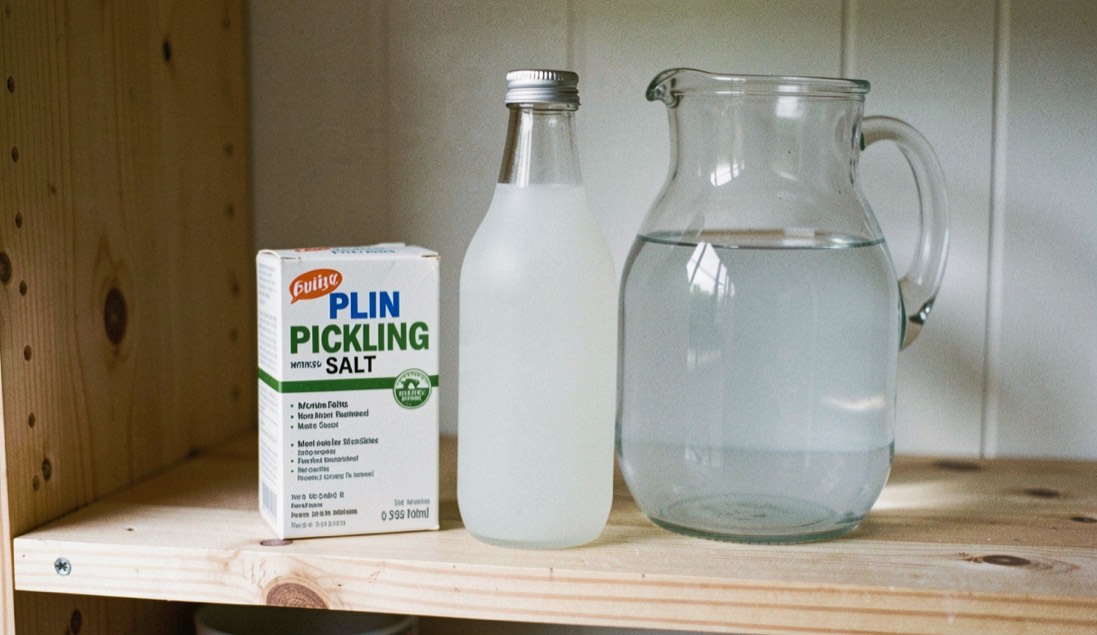
Every recipe in this manual assumes a specific salt, a specific vinegar, and a specific kind of water. On a shop shelf the three ingredients look interchangeable: salt is salt, vinegar is vinegar, water is water. The published guidance says otherwise, and it gives a reason for each restriction. This page collects those reasons, names the publication behind each one, and flags the one point where the sources do not agree.
The salt the recipes assume: canning or pickling salt
The recommendation is uniform across the sources. The National Center for Home Food Preservation states that "Use of canning or pickling salt is recommended," and adds, in its general fermentation guidance, that "Noncaking material added to other salts may make the brine cloudy." Clemson's guide says "Pure granulated salt, such as 'pickling' or 'canning' salt should be used." Colorado State prescribes "non-iodized canning or pickling salt." Penn State describes the product plainly: canning and pickling salt is "pure salt, no additives," and "This type of salt is the best choice for canning, pickling, and sauerkraut."
The reason behind the recommendation is the one the NCHFP gives: other salts carry additives, and the anti-caking material in table salt "may make the brine cloudy." Oregon State's PNW 355 says the same thing in its own words: "Table salt may be used, but the additive that prevents caking may make the brine cloudy." So the additive is a cloudiness problem, and the iodine question is separate.
Iodized salt: the one point where the sources disagree
This is the only contradiction in the salt guidance, and it should be reported as a contradiction, not resolved. On one side, the NCHFP's page on salts states that "Fermented and non-fermented pickles may be safely made using either iodized or non-iodized table salt." In other words, iodized salt is safe there, merely less tidy.
On the other side, Penn State does not recommend iodized salt, because it "may cause them to darken, discolor, or be spotty," and Colorado State simply prescribes a non-iodized canning or pickling salt. A further complication: another NCHFP page, the one on problems, lists "Iodized salt used" among the causes of dark or discolored pickles. So the same publisher says on one page that iodized salt is safe, and on another page that it is a known cause of discoloration.
Both positions are reproduced here without arbitration. What all the sources do agree on is that canning or pickling salt is the best choice, and that none of the texts quoted here frames iodized salt as a safety question; they divide on whether it is discouraged or merely less tidy, and this page does not settle that.
Use canning or pickling salt, 5 percent vinegar, and soft water
If you take one rule from this page: use canning or pickling salt, a vinegar of 5 percent acidity that you never dilute unless the recipe tells you to, and soft water. Every published restriction in this chapter follows from those three choices.
Kosher salt, sea salt, and reduced-sodium salt
Kosher salt occupies a specific spot in the guidance. Penn State calls it "a coarse, flaked pure salt usable for canning," but "not recommended for making pickled and fermented foods," because its density varies from brand to brand. Oregon State's PNW 355 is firmer: "Do not use flake salt or kosher salt because they vary in density. Do not use rock salt or sea salt, which have impurities." The NCHFP condemns only flake salt outright, "Flake salt varies in density and is not recommended for use," and does not rule on kosher salt in the text cited here.
Sea salt gets a reason of its own from Penn State: its minerals "may cause canned foods to discolor or affect the flavor."
Reduced-sodium salt has a split rule. It is allowed in quick pickles, where Penn State notes it may change the taste, and forbidden in ferments. The NCHFP states that "Use of reduced-sodium salt in fermented pickle recipes is not recommended," and PNW 355 adds a caution in its own words: "Caution: Do not use reduced-sodium salt in brined pickles or sauerkraut."
One vocabulary trap, flagged by PNW 355 itself: that publication carries a recipe titled Quick kosher dills. There, "kosher" names the style of the recipe, garlic and dill, not the salt used; the recipe calls for pickling salt.
The vinegar: 5 percent acidity, and never dilute it
Vinegar is treated as a safety ingredient, not a flavoring. PNW 355 states it flatly: "Vinegar is the most important ingredient in quick-pickle recipes. Without an adequate amount, the pickles will not be safe to eat. Use any vinegar with 5% acidity." The NCHFP's general pickle guidance requires "Use of a vinegar of 5 percent acidity (50 grain)" and instructs: "Do not alter vinegar, food, or water proportions in a recipe or use a vinegar with unknown acidity."
The reason is stated by the NCHFP in one sentence: "There must be a minimum, uniform level of acid throughout the mixed product to prevent the growth of botulinum bacteria." Dilution lowers that level, which is why the ban on diluting is repeated everywhere. PNW 355 prints a caution of its own: "Caution: Do not reduce the amount of vinegar or increase the amount of water in a recipe. For a less sour taste, add a small amount of sugar." Penn State adds: "Do not dilute the vinegar unless the recipe says to do so," and never use "homemade vinegar or vinegar of unknown acidity in pickling." Colorado State says the same: "Use a high-grade cider or white distilled vinegar of 5 percent acidity (50 grain)," and "Do not use homemade vinegars or vinegars of unknown acidity."
PNW 355 also gives a proportion rule for quick pickles: "Fresh or quick-pack pickle recipes should have at least as much vinegar as water."
Choosing between cider and white distilled vinegar
Once the 5 percent acidity requirement is met, the choice between cider and white distilled vinegar is a matter of quality and appearance, not safety. PNW 355 gives the published comparison:
- "White distilled vinegar has a pungent taste. Use it when pickling light-colored foods such as cauliflower and onions."
- "Cider vinegar has a milder flavor. It will make a darker brine."
Penn State adds one condition: the vinegar should be pasteurized.
Water: the published procedure for hard water
Soft water is the assumed default. PNW 355 states that "Soft water makes the best brine for pickles. Hard water may cause cloudiness in the brine and discolor pickles." If only hard water is available, PNW 355 publishes this procedure: "boil and let it sit for 24 hours. Skim off scum and use water from the top of the container without disturbing any sediment."
Clemson's HGIC 3100 gives the reason hard water matters and a longer version of the same procedure: hard water "may interfere with the formation of acid and prevent pickles from curing properly." Clemson's version says to boil the hard water 15 minutes, let it stand covered 24 hours, then pour off the top water, leaving the sediment behind. Clemson also notes that distilled water works but costs more.
The other sources add causes and remedies. Penn State explains that hard water rich in calcium and magnesium leaves a "white precipitate that clouds the brine," and that iron "can darken light-colored foods"; it suggests bottled filtered water or a commercial treatment unit. The NCHFP's problems page lists "Minerals in hard water" as a cause of dark pickles, and Colorado State specifies that "discolored pickles may be caused by iron from hard water or an iron cooking utensil."
What this page does not say: chlorinated water. None of the accepted sources consulted, the NCHFP, the USDA guide as republished by the NCHFP, Oregon State's PNW 355, Penn State, Colorado State, or Clemson, addresses chlorinated water or dechlorination before fermentation. Nothing is published on that question in the material behind this manual, so nothing is claimed here. The settled question is hard water; chlorinated water is not a settled question in these sources.
Sources of the figures on this page
- National Center for Home Food Preservation, University of Georgia, Salts Used in Pickling, adapted from the USDA Complete Guide to Home Canning, revised 2015. Which salt is recommended for pickling, and what iodised salt and anticaking agents do to the jar.
- Penn State Extension, Let us Preserve: Ingredients Used in Home Food Preservation, updated September 3, 2019. Which salt to use, why vinegar must be 5 percent and must not be diluted, and what hard water does.
- Clemson Cooperative Extension, Home and Garden Information Center, Pickle Basics, HGIC 3100, published November 1999, updated March 20, 2012. The four classes of pickle, the published procedure for hard water, and the requirement for a pure salt.
- Colorado State University Extension, Making Pickles, published October 1999, reviewed October 2011. Non iodised salt, 5 percent vinegar, the prohibition on altering proportions, and the instruction to destroy soft or slimy pickles.
- National Center for Home Food Preservation, University of Georgia, General Information on Pickling, adapted from the USDA Complete Guide to Home Canning, revised 2015, reviewed February 2018. The four classes of pickled product, the 5 percent vinegar requirement, and the prohibition on altering proportions.