How the method works
Crock, weight, cover and jar, and the rule attached to each
Four objects, and the reason each one is specified rather than suggested: every rule here comes from the same documents as the recipes.
On this page
On this page
- The crock: one gallon of capacity for five pounds of vegetables
- What counts as a weight
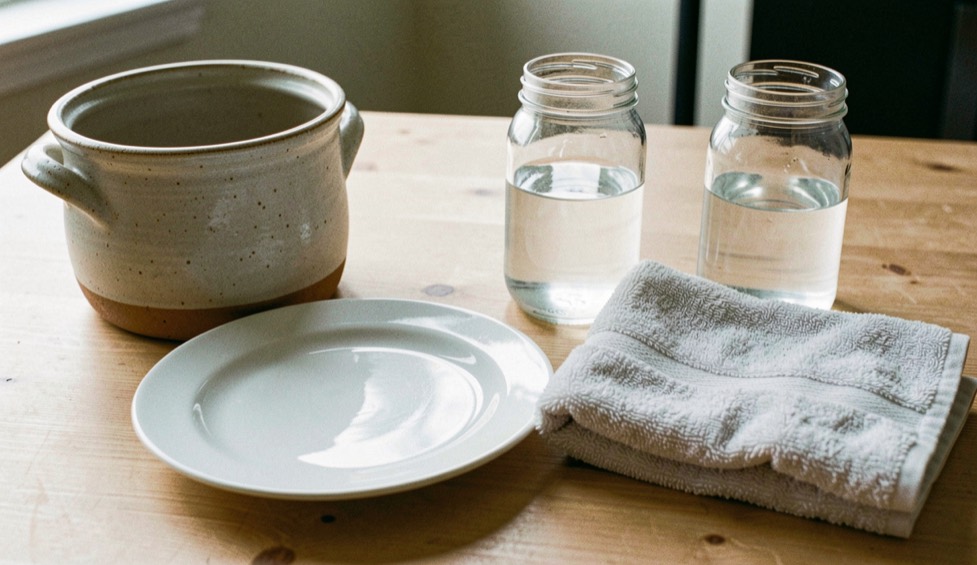
- The cover: a clean, heavy bath towel
- Scum: what forms on the surface and what to do
- The jar: half an inch of headspace, and a processing time that changes with altitude
- Storage in the original container, before any jar is involved
Every fermented pickle or sauerkraut recipe in this manual names the same four pieces of equipment: a crock, a weight, a cover, and, at canning time, a jar. None of them is a suggestion. Each one carries a rule printed in the same documents as the recipes themselves: the national guide from the National Center for Home Food Preservation, Oregon State's PNW 355, Clemson's HGIC 3380, and Penn State's fermentation material.
The crock: one gallon of capacity for five pounds of vegetables
The published ratio is simple: allow 1 gallon of container capacity for each 5 pounds of fresh vegetables. Oregon State's PNW 355 and the national guide both print it, and both add that a 5-gallon crock or stone jar holds approximately 25 pounds of vegetables. Depth matters as much as width: the container must be deep enough to keep the vegetables 1 to 2 inches under the brine while fermenting. The national guide, PNW 355, and Clemson's HGIC 3380 all state this submersion depth, and Penn State's fermentation material says plainly: "Keep the cabbage or pickles submerged at all times."
The material of the container is regulated by what is forbidden rather than what is recommended. The national guide states: "Do not use garbage bags or trash liners." PNW 355 goes further: "It is not safe to use garbage cans or other containers that are not made to come into contact with food for humans." On metals, PNW 355 prints: "Do not use zinc, copper, brass, galvanized metal or iron utensils. These metals may react with acid or salt and affect the quality (color changes) and safety of pickles." Penn State says to avoid "copper, iron, or galvanized metal containers or lead-glazed crocks," and Clemson adds aluminum to the list.
What counts as a weight
The sources define the term directly: "A weight keeps fermenting food under the brine" (PNW 355). The published devices are two. The first is a dinner plate or pie plate slightly smaller than the container opening, weighted with two or three sealed quart jars filled with water. The second is a large food-grade bag filled with brine.
If you use the bag, the liquid inside must be brine, not plain water. The recipe is 1½ tablespoons of salt per quart of water, and PNW 355 gives the reason: "Using brine prevents dilution in case the bag leaks." A bag of plain water that leaks would dilute the fermentation brine, and both "insufficient amount of brine" and "salt brine too weak during fermentation" appear in the national guide's published list of causes of failure.
The one rule to carry to the counter
The vegetables stay 1 to 2 inches under the brine, held there by a weighted plate or a brine-filled bag, and the whole container is covered with a clean, heavy bath towel. Every other detail follows from keeping the food submerged.
The cover: a clean, heavy bath towel
The cover is not a lid. The national guide and PNW 355 both direct that the container be covered "with a clean, heavy bath towel to prevent contamination from insects and molds during fermentation." The towel is the published barrier against insects and mold while carbon dioxide from the fermentation escapes. No source in this manual recommends or defines an airlock; the published devices remain the weighted plate, the brine bag, and the towel.
Scum: what forms on the surface and what to do
Scum is the film that forms on the surface of the brine during fermentation. The national guide names its cause: "Wild yeasts and bacteria that feed on the acid thus reducing the concentration if allowed to accumulate." Colorado State describes a "white or pink yeast scum" that "can be removed and discarded." The instruction attached to it appears in the fermented dill pickle recipe: "Check the container several times a week and promptly remove surface scum or mold" (the national guide). The term "kahm yeast" appears in none of the accepted sources; the published word for this film is scum.
The jar: half an inch of headspace, and a processing time that changes with altitude
Headspace is "the space between the packed food and liquid and the top of the jar" (PNW 355). Every recipe in this manual's source material uses ½ inch of headspace, "unless otherwise specified" (PNW 355). The publication also prints the consequences of getting it wrong: too little headspace and food may siphon out during processing and prevent a proper seal; too much and the air trapped in the jar may not be driven out.
When fermented dill pickles are canned in a boiling water bath, hot pack, the processing time depends on jar size and altitude. The national guide and PNW 355 print the following table; Clemson's HGIC 3380 confirms the 0 to 1,000 foot row only, and they print:
| Jar size | 0 to 1,000 ft | 1,001 to 6,000 ft | Above 6,000 ft |
|---|---|---|---|
| Pint | 10 min | 15 min | 20 min |
| Quart | 15 min | 20 min | 25 min |
Two cautions ride along with the canning step. PNW 355 states: "Fermented pickles must not be processed until they have a sour taste," and prints in bold: "It is extremely important to wait until fermented pickles taste tart before processing." The alternative low-temperature pasteurization method, 180 to 185°F for 30 minutes, carries its own warning from the national guide: "Use only when recipe indicates."
Storage in the original container, before any jar is involved
Refrigerated in the original fermentation container, fermented dill pickles keep 4 to 6 months, with regular removal of scum and mold, according to the national guide, PNW 355, and Clemson's HGIC 3380. This is the storage the sources print for the crock itself; the jar and its altitude table belong to the canning step alone.
This page does not tell you how to make the brine itself, how much salt goes into a quart of cucumbers, or how long fermentation runs at a given temperature; those figures belong to the recipe pages and are printed there with the same source names. It also says nothing about airlocks or fermentation lids: no accepted source defines or recommends one, so nothing is published, and the rule stands with the plate, the bag, and the towel.
Sources of the figures on this page
- National Center for Home Food Preservation, University of Georgia, Suitable Containers, Covers and Weights for Fermenting Food, extracted from the USDA Complete Guide to Home Canning, AIB 539, revised 2009. One gallon of capacity per five pounds of vegetable, the plate and jar weight, the brine filled bag, and one to two inches under the brine.
- Oregon State University Extension Service, Pickling Vegetables, PNW 355, by Jeanne Brandt, revised July 2019, reviewed 2024. Equipment, water, salt and vinegar, the fermentation procedures and seventeen tested recipes.
- Penn State Extension, Let us Preserve: Fermentation, Sauerkraut and Pickles, updated May 22, 2023. Ratios, containers, temperatures, the prohibition on changing proportions, and the criteria for discarding a batch.
- National Center for Home Food Preservation, University of Georgia, Dill Pickles, in the fermenting recipes, adapted from the USDA Complete Guide to Home Canning, AIB 539, revised 2015. Quantities, container, weight, fermentation temperature and duration, storage and the boiling water schedule for fermented cucumbers.