Vegetable by vegetable
Fermented dill pickles, cucumber by the gallon of crock
The oldest and the most documented of these recipes, printed the same way by four separate publications, all of them adapted from one national guide.
On this page
On this page
- Quantities for one gallon of container capacity
- Why the blossom end comes off and the stem stays on
- Container, weight, and depth under the brine
- The two temperature windows and their durations
- Watching the crock and removing scum
- Storage and canning
- The low-temperature pasteurization alternative and its caution
Four separate publications print this recipe in the same words: the national guide, Oregon State's PNW 355, Clemson's HGIC 3380, and Penn State. All four adapted it from the same source, the USDA Complete Guide to Home Canning, and all four agree. That agreement is what makes this recipe solid: nothing here depends on one publisher's judgment.
Quantities for one gallon of container capacity
The recipe is measured by the capacity of the fermentation container, not by the jar. Per gallon of container, the national guide, PNW 355, Clemson, and Penn State all print:
- 4 lbs of 4-inch pickling cucumbers
- 2 tbsp dill seed, or 4 to 5 heads of fresh or dry dill
- 1/2 cup of salt. Clemson specifies "pure granulated salt ('pickling' or 'canning' salt)"
- 1/4 cup of 5 percent acidity vinegar
- 8 cups of water
Do not cut back on the salt. The national guide states that you should not attempt to make sauerkraut or fermented pickles by cutting back on the salt required, and it does not recommend reduced-sodium salt in fermented pickle recipes.
Optional: 2 cloves of garlic, 2 dried red peppers, and 2 tsp of pickling spice, per the national guide and PNW 355.
No source publishes a brine percentage for cucumber. The salt is given by volume in cups against a volume of water, and no accepted publication converts it into a percent strength. Do not look for one here, and treat any percentage you see elsewhere with caution.
Why the blossom end comes off and the stem stays on
The national guide and PNW 355 instruct: "Wash cucumbers. Cut 1/16-inch slice off blossom end and discard. Leave 1/4-inch of stem attached." The trimming is not cosmetic. The blossom end carries enzymes that soften the pickle during fermentation, and the national guide lists "Blossom ends not removed from cucumbers" among the published causes of soft or slippery pickles. The 1/16-inch slice removes it; the 1/4 inch of stem is left attached to hold the cucumber together.
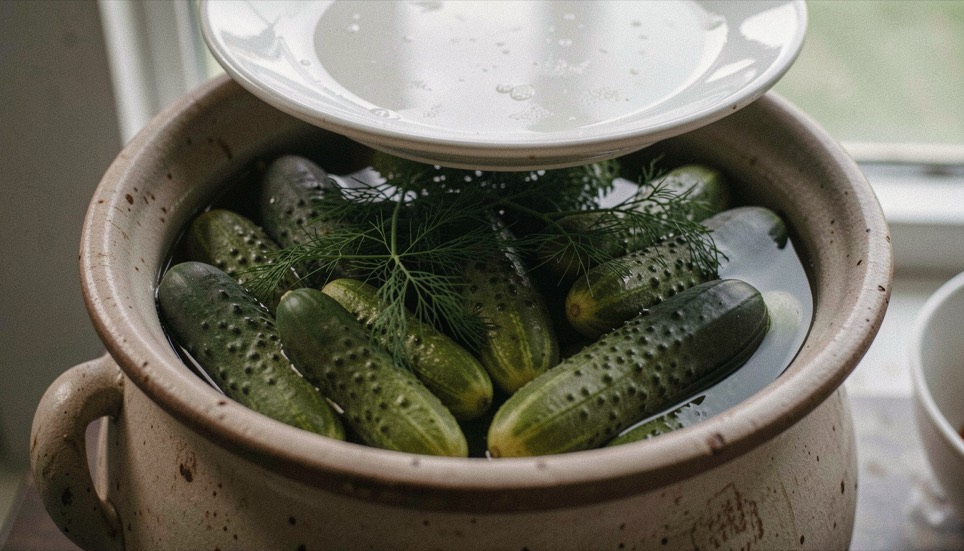
Put half the dill and spices at the bottom of the container, pack the cucumbers, and put the rest on top. Dissolve the salt in the vinegar and water, then pour the brine over the cucumbers, per PNW 355.
Container, weight, and depth under the brine
Size the container by weight: 1 gallon of capacity for 5 lbs of fresh vegetables, and a 5-gallon crock holds about 25 lbs, per the national guide and PNW 355. Keep the vegetables 1 to 2 inches below the surface of the brine, and cover the container with a clean, thick bath towel.
To hold everything down, use a dinner plate slightly smaller than the container opening, weighted with two or three sealed quart jars filled with water. PNW 355 also allows a large food-grade bag filled with brine, at 1 1/2 tbsp of salt per quart of water. The reason for the brine in the bag is printed plainly: "Using brine prevents dilution in case the bag leaks."
The two temperature windows and their durations
All four sources print the same two windows, and the same warning above them:
| Temperature range | Published duration |
|---|---|
| 70 to 75 °F (21 to 23 °C) | 3 to 4 weeks |
| 55 to 65 °F (12 to 18 °C) | 5 to 6 weeks |
| Above 80 °F (26 °C) | To be avoided |
The reason for the ceiling is printed in PNW 355: "Pickles will become too soft if temperatures are above 80°F during fermentation." The national guide also lists "Cucumbers stored at too high a temperature during fermentation" among the causes of soft or slimy pickles. No accepted source publishes a curve of acidification speed or pH against temperature; that data does not exist in this literature.
Watching the crock and removing scum
During fermentation, "Check the container several times a week and promptly remove surface scum or mold," per the national guide and PNW 355. The scum matters: the national guide attributes it to "wild yeasts and bacteria that feed on the acid thus reducing the concentration if allowed to accumulate."
If the pickles go bad, they go bad in ways you can see and smell. All four sources print the same instruction: "If the pickles become soft, slimy, or develop a disagreeable odor, discard them." Colorado State says the same thing in stronger words: "Soft, slippery, or slimy pickles are spoiled and should be destroyed."
Storage and canning
In the original container, refrigerated, the pickles keep 4 to 6 months, with regular removal of scum and mold, per the national guide, PNW 355, and Clemson. Do not process these pickles until they taste tart. PNW 355 prints the caution in full: "It is extremely important to wait until fermented pickles taste tart before processing." Once they are sour, and canning is the method the sources present as the better one, bring the brine to a boil and simmer 5 minutes; filter it through a paper coffee filter if you want to reduce cloudiness. Fill hot pint or quart jars, leaving 1/2 inch of headspace, then process in a boiling water bath:
| Jar size | 0 to 1,000 ft | 1,001 to 6,000 ft | Above 6,000 ft |
|---|---|---|---|
| Pint | 10 min | 15 min | 20 min |
| Quart | 15 min | 20 min | 25 min |
These times are printed by the national guide and PNW 355; Clemson prints the 0 to 1,000 ft line.
The low-temperature pasteurization alternative and its caution
The national guide and PNW 355 also publish a low-temperature pasteurization treatment: hold the water at 180 to 185 °F for 30 minutes, with the jars set in a canner half filled with warm water at 120 to 140 °F, then filled to 1 inch above the jars. This treatment is not interchangeable with the boiling water bath on your own judgment. Both sources print the warning verbatim: "Caution: Use only when recipe indicates." A process that runs too cool does not preserve safely, so follow the printed temperatures exactly or use the boiling water bath table above.
Keep the cucumbers 1 to 2 inches under the brine, check the crock several times a week, and remove surface scum or mold promptly.
Exposed cucumbers and accumulated scum are the two failures this recipe's instructions exist to prevent, and every source on this page prints both.
What this page does not tell you: no source publishes a brine percentage for cucumber fermentation, only the volume recipe given above. The sauerkraut fermentation schedule, the published signs of spoilage inside an opened jar, and the detoxification procedure for a suspect sealed batch are treated on their own pages, and none of that material is repeated or adapted here.
Sources of the figures on this page
- National Center for Home Food Preservation, University of Georgia, Dill Pickles, in the fermenting recipes, adapted from the USDA Complete Guide to Home Canning, AIB 539, revised 2015. Quantities, container, weight, fermentation temperature and duration, storage and the boiling water schedule for fermented cucumbers.
- Oregon State University Extension Service, Pickling Vegetables, PNW 355, by Jeanne Brandt, revised July 2019, reviewed 2024. Equipment, water, salt and vinegar, the fermentation procedures and seventeen tested recipes.
- Clemson Cooperative Extension, Home and Garden Information Center, Dill Pickles and Sauerkraut, HGIC 3380, revised February 5, 2002. A second published statement of the two fermented recipes and their low altitude schedules.
- Penn State Extension, Let us Preserve: Fermentation, Sauerkraut and Pickles, updated May 22, 2023. Ratios, containers, temperatures, the prohibition on changing proportions, and the criteria for discarding a batch.
- National Center for Home Food Preservation, University of Georgia, Suitable Containers, Covers and Weights for Fermenting Food, extracted from the USDA Complete Guide to Home Canning, AIB 539, revised 2009. One gallon of capacity per five pounds of vegetable, the plate and jar weight, the brine filled bag, and one to two inches under the brine.
- National Center for Home Food Preservation, University of Georgia, Low-Temperature Pasteurization Treatment, extracted from the USDA Complete Guide to Home Canning, AIB 539, revised 2009. The 180 to 185 F for 30 minutes alternative, and the warning that it is used only where a recipe calls for it.