Vegetable by vegetable
Quick fresh pack dills, the cucumber that never ferments
No lactic bacteria, no crock and no three weeks: acidity arrives ready made in the jar, which changes what the recipe is allowed to do.
On this page
On this page
A fresh-pack dill pickle is not a fermented pickle with the waiting removed. It is a different product built on a different source of acid. As Oregon State's PNW 355 puts it, quick unfermented pickles "are made in one or two days by adding acid in the form of vinegar," while brined pickles "require several weeks of curing at room temperature," during which "acid is produced as lactic acid bacteria grow." The jar you make today is, chemically speaking, finished today.
What the soaking step is for, and what it is not
The national guide (NCHFP, adapted from the USDA Complete Guide to Home Canning) opens its Quick Fresh-Pack Dill Pickles recipe with a brine that looks like the start of a fermentation: "Dissolve ¾ cup salt in 2 gals water. Pour over cucumbers and let stand 12 hours. Drain." This is not a fermentation. The 12-hour soak is brining, and the national guide classifies fresh-pack pickles as products that "are not fermented; some are brined several hours or overnight, then drained and covered with vinegar and seasonings." The soak is a preparation step, then it ends. No bacteria are expected to do any work.
The full recipe as published
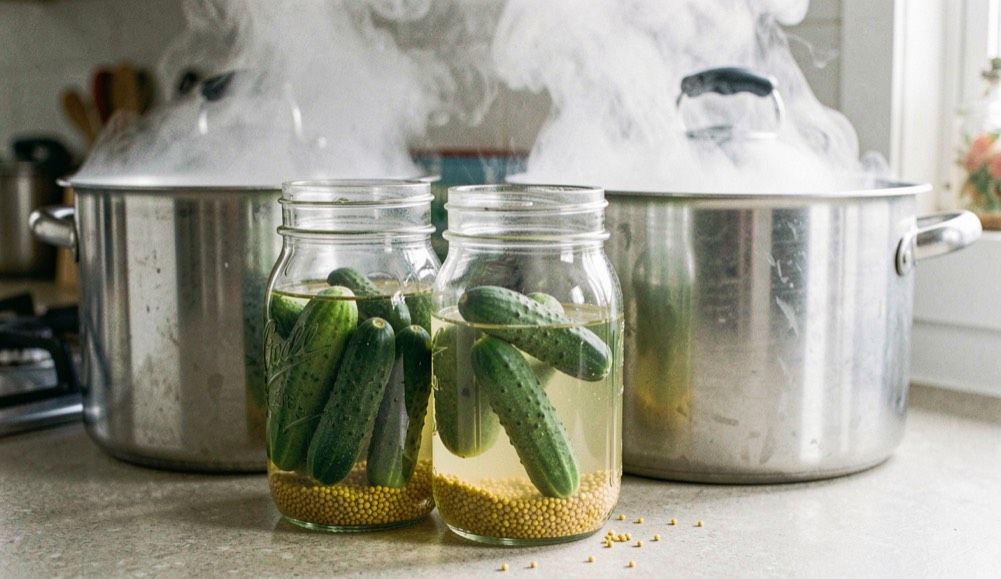
The recipe yields 7 to 9 pints. You need 8 lbs of pickling cucumbers, 3 to 5 inches long. After the 12-hour soak and drain, you make a pickling solution of 1½ qts of 5% vinegar, ½ cup salt, ¼ cup sugar, and 2 quarts of water.
- 2 tbsp whole pickling spice
- about 3 tbsp mustard seed, roughly 1 to 2 tsp per pint
- about 14 heads of fresh dill, 1½ per pint, or 4½ tbsp dill seed
Headspace is ½ inch.
Processing times by jar size and altitude
The national guide prints this table, and the same numbers appear in Oregon State's kosher variant. Altitude matters, so check it before you set the timer.
| Jar size | 0 to 1,000 ft | 1,001 to 6,000 ft | Above 6,000 ft |
|---|---|---|---|
| Pint | 10 min | 15 min | 20 min |
| Quart | 15 min | 20 min | 25 min |
The one rule of fresh-pack
Vinegar is the acid, so vinegar must be enough. Oregon State's PNW 355 states it plainly: "It is critical to add enough vinegar to prevent bacterial growth." Never cut the vinegar, never dilute it below what the recipe prints.
The Oregon State kosher variant
Oregon State's PNW 355 publishes a Quick kosher dill recipe that runs on the same principle with a different flavor base. It uses 4 lbs of 4-inch cucumbers, 3 cups water plus 3 cups of 5% vinegar, ¼ cup of canning and pickling salt, 14 split garlic cloves, 14 dill heads, 28 peppercorns, and, optionally, 2 tsp of hot red pepper flakes. It yields 6 to 7 pints or 3 to 4 quarts. Headspace is ½ inch, and it is a raw pack. The processing times are identical to the main recipe: pints 10, 15 or 20 minutes and quarts 15, 20 or 25 minutes depending on altitude.
What fresh-pack guarantees, and what it does not
In a lactic fermentation, acid is produced inside the jar by bacteria over weeks of curing, and salt "favors the growth of desirable bacteria while inhibiting the growth of others" during that time, according to the national guide's fermentation pages. In a fresh-pack, the acid arrives ready made in the vinegar, and acidity is the barrier from the moment the solution meets the cucumber. That is the whole trade: you skip the curing, and you accept that the recipe's vinegar ratio is doing the protective work the salt-and-bacteria alliance would otherwise do.
Timing follows from this. The national guide says regular dill pickles and sauerkraut cure "for about 3 weeks," and refrigerator dills "for about 1 week." A fresh-pack is done in one or two days (PNW 355). And the two methods have opposite rules for when to process. For fermented pickles, "It is extremely important to wait until fermented pickles taste tart before processing" (PNW 355), because taste is the only published end-of-process check. For quick pickles there is no such check at all, because there is nothing to wait for: "Quick pickles must be processed as soon as they are made" (PNW 355). Waiting is not neutral here, it is the error.
What makes either product shelf stable at room temperature is not the acid source but the heat treatment in the jar, whether a boiling water bath or low-temperature pasteurization (NCHFP; PNW 355). Oregon State also notes that "canning is a better way to store fully fermented pickles," a statement made about fermented pickles only; no accepted source extends it to this fresh-pack recipe.
What the sources do not say
No accepted source publishes a pH value reached by a home fermentation, nor any home method for verifying that a fermented batch has gone below 4.6. Nothing here claims that fermentation destroys a pathogen present at the start, or that an unheated ferment stores outside a refrigerator. Refrigerated storage is its own regime, not a weakened form of canning: under 21 CFR 114.3(b), foods stored, distributed, and retailed under refrigeration are excluded from the Acidified Foods regulation.
This page does not give refrigerated storage life for unprocessed fresh-pack pickles. The published refrigerator figures, 4 to 6 months for brined pickles kept in their original container with surface scum and mold removed regularly, come from the national guide's fermented dill pages and do not transfer to a vinegar pack. No accepted source publishes an equivalent number for this recipe, and none is offered here.
Sources of the figures on this page
- National Center for Home Food Preservation, University of Georgia, Quick Fresh-Pack Dill Pickles, adapted from the USDA Complete Guide to Home Canning, revised 2015. The twelve hour salt soak, the pickling solution, the headspace and the processing schedule for fresh pack cucumbers.
- Oregon State University Extension Service, Pickling Vegetables, PNW 355, by Jeanne Brandt, revised July 2019, reviewed 2024. Equipment, water, salt and vinegar, the fermentation procedures and seventeen tested recipes.
- National Center for Home Food Preservation, University of Georgia, General Information on Pickling, adapted from the USDA Complete Guide to Home Canning, revised 2015, reviewed February 2018. The four classes of pickled product, the 5 percent vinegar requirement, and the prohibition on altering proportions.
- Penn State Extension, Let us Preserve: Ingredients Used in Home Food Preservation, updated September 3, 2019. Which salt to use, why vinegar must be 5 percent and must not be diluted, and what hard water does.