Vegetable by vegetable
Mixed vegetables, the only recipe here with no added water
The recipe that shows most plainly what the vinegar is doing, because there is nothing in the jar to dilute it.
On this page
On this page
Most pickled vegetable recipes balance vinegar with water. This one does not. The NCHFP recipe for Pickled Mixed Vegetables, carried in the USDA's 2015 revision of its complete guide to home canning, calls for 5 cups of 5 percent white vinegar and no added water at all. That single fact is what makes the recipe worth studying closely: nothing in the jar dilutes the acid, so the vinegar's role as the preserving medium stands in plain view.
What the recipe yields and what goes into it
The NCHFP gives a yield of about 10 pints. The vegetable mix and the pickling solution are printed together, and the quantities matter because this is a weighted, tested formula rather than a loose suggestion:
- 4 lbs of pickling cucumbers, 4 to 5 inches long, washed and cut into 1 inch pieces
- 2 lbs of small onions, peeled and quartered
- 4 cups of celery cut into 1 inch pieces
- 2 cups of peeled carrots cut into ½ inch pieces
- 2 cups of sweet red peppers cut into ½ inch pieces
- 2 cups of cauliflowerets
- 5 cups of white vinegar at 5 percent acidity, with no water added
- ¼ cup of prepared mustard
- ½ cup of canning or pickling salt
- 3½ cups of sugar
- 3 tbsp of celery seed
- 2 tbsp of mustard seed
- ½ tsp of whole cloves
- ½ tsp of ground turmeric
Why the missing water is the whole point of the page
In nearly every other vinegar pickle, water cuts the vinegar and the ratio of acid to volume becomes the safety question. Here the NCHFP prints no water at all, which means the liquid in the jar is vinegar at its labeled strength, modified only by the sugar, salt, and spices dissolved into it and by the moisture the vegetables themselves release. The recipe therefore shows most plainly what the vinegar is doing: it is not a flavoring added to a brine, it is the brine. When you drain the vegetables at the end and keep the solution, as the NCHFP instructs, what you are filling jars with is that undiluted vinegar solution.
One rule to carry out of this page
Do not add water to this recipe, and do not reduce the vinegar. The 5 cups of 5 percent vinegar with no added water is what the tested processing times are built on.
The ice step, three to four hours under refrigeration
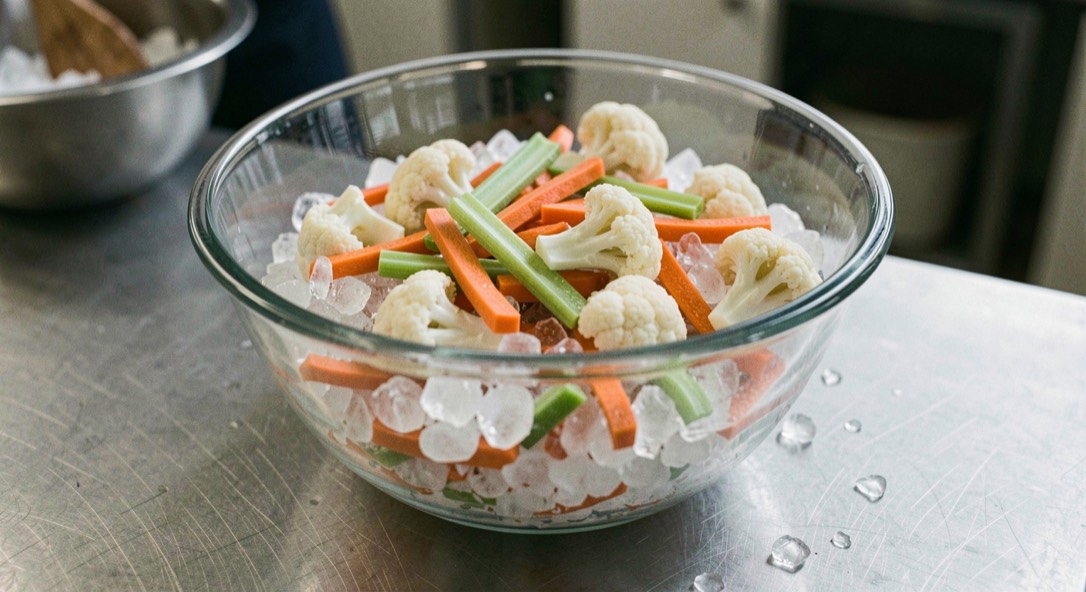
Before cooking, the NCHFP has you cover the vegetables with 2 inches of crushed or cubed ice and refrigerate them for 3 to 4 hours. Drain the vegetables before they go into the pot. The guide does not explain the purpose of this step, so this manual will not invent one; the instruction is printed as part of the tested procedure and is followed as written.
Cooking the vegetables in the vinegar solution
The NCHFP directs you to use an 8 quart kettle. Combine the vinegar and the prepared mustard, then add the salt, sugar, and spices, and bring the mixture to a boil. Add the drained vegetables, cover, and slowly return the contents to a boil. Then drain the vegetables again, but this time keep the solution: it becomes the jar liquid.
Headspace, jar preparation, and the two processing scales
Fill jars with vegetables first, then the reserved solution, leaving ½ inch of headspace, as the NCHFP specifies. Pints must be sterilized for this recipe; quarts need only be clean. That distinction is unusual, and the NCHFP prints it without explanation, so it is reported here the same way.
The processing times come in two scales, one for pints and one for quarts, each broken out by altitude exactly as the NCHFP prints them:
| Altitude | Pints | Quarts |
|---|---|---|
| 0 to 1,000 ft | 5 min | 10 min |
| 1,001 to 6,000 ft | 10 min | 15 min |
| Above 6,000 ft | 15 min | 20 min |
A note on the cucumbers in the mix
This is the only mixed vegetable recipe in this manual's collection that includes cucumber. Because cucumber is present, the ordinary caution about cucumber blossoms applies here as well: the published rule for cucumbers is to cut a 1/16 inch slice off the blossom end and discard it, before the cucumbers are cut into 1 inch pieces. The NCHFP page for this recipe prints the ingredient list and procedure but does not restate the blossom note on that page, so it is recalled here rather than quoted from it.
What this page does not tell you: the NCHFP does not publish a shelf life or storage life for these pickled mixed vegetables, and it does not print any reformulated variant of the recipe, no lighter sugar version, no reduced salt version, and no version with added water. Nothing beyond the quantities and times printed above is published for this recipe, and no other source in this manual's collection has been found to extend it.
Sources of the figures on this page
- National Center for Home Food Preservation, University of Georgia, Pickled Mixed Vegetables, adapted from the USDA Complete Guide to Home Canning, guide 6, revised 2015. Five cups of 5 percent vinegar with no added water, the three to four hour ice step, and both jar schedules.
- United States Department of Agriculture, Complete Guide to Home Canning, Agriculture Information Bulletin 539, guide 6, Preparing and Canning Fermented and Pickled Foods, revised 2015. The canon these extension leaflets adapt, and by its silences, the vegetables for which nothing is published.
- National Center for Home Food Preservation, University of Georgia, General Information on Pickling, adapted from the USDA Complete Guide to Home Canning, revised 2015, reviewed February 2018. The four classes of pickled product, the 5 percent vinegar requirement, and the prohibition on altering proportions.