Vegetable by vegetable
Pickled beets, cooked before they are ever pickled
The only recipe here that cooks the vegetable through first, and the only one whose preparation step exists to keep the colour in the beet.
On this page
On this page
- Seven pounds of beets and the pickling solution around them
- Why the stem and the roots stay on during the boil
- Boiling, peeling, and slicing to a quarter inch
- The processing times, printed on four altitude tiers
- Salt in this recipe is not doing preservation work
- The whole-beet variant that is also published
- What this page does not say
This is the only recipe in the manual whose vegetable is cooked all the way through before it ever meets the brine. The beet arrives at the jar already tender, already peeled, already sliced, and the pickling step that follows is a flavoring and packing step, not a cooking one. The recipe printed here is the one the national guide publishes in Guide 6, page 6-15, revised 2015, and it is the same recipe Oregon State's PNW 355 reprints. Where the two differ in what they spell out, both are given below.
Seven pounds of beets and the pickling solution around them
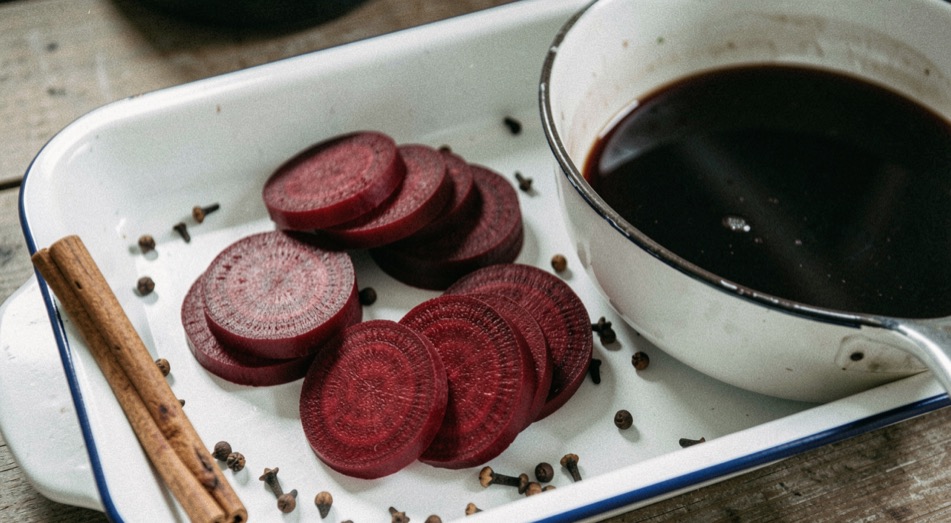
Both publications call for 7 lbs of beets, 2 to 2½ inches in diameter. The solution is 4 cups of 5 percent vinegar, 2 cups of water, 2 cups of sugar, and 1½ teaspoons of canning or pickling salt, spiced with 2 cinnamon sticks and 12 whole cloves. The published quantities work out to two parts vinegar for one part water; neither publication prints that ratio as such. Onions are optional: 4 to 6 onions, each 2 to 2½ inches, if you use them. Yield is about 8 pints or 4 quarts.
The spice measurements differ slightly in form between the two publications. Oregon State's PNW 355 lists 2 cinnamon sticks and 12 cloves as direct ingredients. The national guide ties the whole spices in a spice bag before they go into the liquid, so they can flavor the syrup without staying in the jars. Neither source says one method is required over the other; the direct quote from the national guide for the simmer step is: "Add beets and onions. Simmer 5 minutes."
Why the stem and the roots stay on during the boil
The beet is the one vegetable in this manual whose trimming is done to protect a color. The instruction is printed word for word by the national guide: "Trim off beet tops, leaving 1 inch of stem and roots to prevent bleeding of color." Oregon State's PNW 355 gives the same instruction in its preparation sequence. If you cut the tops and the root tail off before boiling, the red bleeds into the cooking water and the beet comes out washed out. The published reason is the color, nothing else.
One more instruction sits right after the boil in the national guide, in caution form: "Caution: Drain and discard liquid." The cooking water is not reused, not measured, not added to anything. It goes down the drain.
Boiling, peeling, and slicing to a quarter inch
The pre-cooking is 25 to 30 minutes in boiling water, until tender, per both the national guide and Oregon State's PNW 355. After that the sequence is: cool, trim, peel, slice. The slice thickness is published as ¼ inch. There is no published range for thickness and no published tolerance; a quarter inch is the number both sources print.
The sliced beets then simmer 5 minutes in the pickling solution before packing, per the national guide. This is a hot pack. Headspace is ½ inch.
What to carry away from this page
Leave 1 inch of stem and the roots on during the 25 to 30 minute boil so the color stays in the beet, discard the cooking liquid, simmer the quarter-inch slices 5 minutes in the solution, leave ½ inch of headspace, and process 30 to 45 minutes depending on altitude.
The processing times, printed on four altitude tiers
This is one of the longest processing schedules in the manual. The times climb in five-minute steps across four altitude bands, and, unusually, pints and quarts take the same time at every band. The table below is the one Oregon State's PNW 355 prints, and the national guide prints the same four figures for both jar sizes.
| Jar size | 0 to 1,000 ft | 1,001 to 3,000 ft | 3,001 to 6,000 ft | Over 6,000 ft |
|---|---|---|---|---|
| Pint | 30 min | 35 min | 40 min | 45 min |
| Quart | 30 min | 35 min | 40 min | 45 min |
Salt in this recipe is not doing preservation work
The 1½ teaspoons of canning or pickling salt in this recipe are there for taste and for the way the brine reads on the palate, not for safety. No accepted source calls this salt a preservative. What preserves the product is the vinegar, the sugar, the hot pack, and the processing time. This matters for how you read the recipe. In a fermented vegetable, salt concentration is the safety-critical number and you weigh it. Here it is a measured seasoning in a vinegar solution, and the vinegar acidity, 5 percent, is the number you cannot change.
The whole-beet variant that is also published
Both publications carry a variant using whole beets of 1 to 1½ inches, left unsliced, with the same preparation instructions otherwise: boil, cool, peel, pack hot, same solution, same headspace, same processing table. In the national guide's version, onions remain optional in this variant as well. Nothing is published about processing whole beets for a different time; the variant runs on the schedule printed above.
The national guide also prints a No Sugar Added Pickled Beets recipe in Guide 6, page 6-32. The quantities for that version were not recorded here, so none are given. Anyone wanting that version should open the source directly before measuring anything.
What this page does not say
No fermented beet recipe is published by any of the accepted sources. Not as a whole-beet ferment, not as a grated or sliced ferment, not in any form: the search result is simply not found. This page therefore gives no salt-to-water ratio for beet fermentation, no fermentation time, no room temperature, and no shelf-life figure for a fermented beet, because none is published. The No Sugar Added variant's quantities are likewise absent here, for the reason stated above. And nothing on this page transfers to raw-pack canning of beets or to plain canned beets; those are different recipes with their own published numbers, and this page does not state them.
Sources of the figures on this page
- Oregon State University Extension Service, Pickling Vegetables, PNW 355, by Jeanne Brandt, revised July 2019, reviewed 2024. Equipment, water, salt and vinegar, the fermentation procedures and seventeen tested recipes.
- National Center for Home Food Preservation, University of Georgia, General Information on Pickling, adapted from the USDA Complete Guide to Home Canning, revised 2015, reviewed February 2018. The four classes of pickled product, the 5 percent vinegar requirement, and the prohibition on altering proportions.